
Tempest Dreams
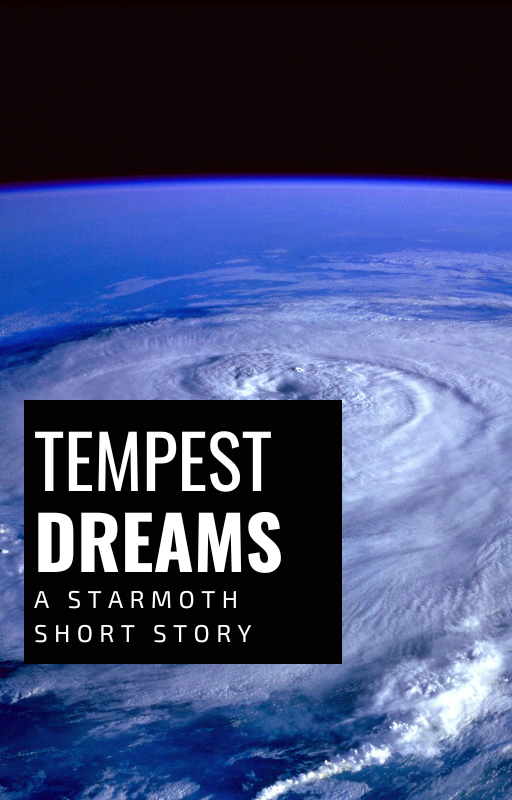
The rain was warm and generous. It came from the sea, carried by the tail end of a storm; it ran down the sapphire windows and into the gardens, muted lights and blind pseudoamphibians perched atop a miniature forest of serene reeds. By the sea gleamed the Saraswati arcology, her pillar linking shore and sky in a river of silver-blue; down into the urban tissue, world-trees whispered to the wind. Isaac-Isabeau sat wide-eyed on their bed. In the sky, all they found was a faint sadness.
“You’re awake,” whispered Talasea.
They shared a bed, yet not a blanket. It was twenty-two degrees Celsius outside, the Pleiadian was cold and the Terran felt warm.
“I haven’t slept,” said Isaac-Isabeau.
They had put their watch face down on the bedside table and lost the measure of time. Yet they could tell midnight had eluded them, for the last spaceplane bound for low orbit had left some time ago in an influx of yellow plumes. Now the maglev runways, far inland in the desolate canyons, remained idle under the storm, silent drones washing burner residue out of their rails. Talasea emerged from the blanket and took Isaac-Isabeau’s hand. They did not retreat; they found her cold, a fragment of an arctic ocean.
“Don’t worry,” they whispered. “Come back to sleep. I’ll ask my monad to secrete a sedative. It has become quite adept at it. Adaptation at work, I suppose.”
“That is not a solution.”
“I am not looking for one. I merely want an exit.”
“Isa.” Talasea looked them in the eyes, and their resolve melted away into a deep serenity. “We have been on Elora for a week and I do not think you’ve had a full night’s sleep. Yet, you’ve already been here. I get that you may take time to attune to a new planet, but this place is familiar to you.”
“Not quite. I’ve never spent so much time on the surface of this planet. Never had the opportunity. And even if I had had it…never had the inclination.”
“Why? Did I make a mistake inviting you here? I thought you’d be right at home on Elora. It is the closest there is to the Earth. The atmospheric pressure, gravity, average temperature, air mix, all are within the optimal parameters to…”
“Tal, I know I once signed a letter *your Terran rose*…”
“Not your best signature.”
“I was tired and madly in love. Yet, and regardless of how much I’d like it to be true, I am no plant. Elora is wonderful. I breathe well, my back doesn’t ache, the light doesn’t hurt my eyes, I don’t have allergies, even the hygrometry is just right for my hair, and you know how rare that is. It’s just that…” They paused. On and on went the rain against the bay windows; elegy for the arcologies. “…it’s not right, Tal. I shouldn’t be here. I do not deserve it.”
“Oh no, Isa, no, no, no, I know you, it is not about self-worth. We are not aboard a spaceship, there is nothing around you that can hurt us, you do not have to shoulder any responsibility, you are not a pilot nor a spationaut anymore, we are together, we are safe, we are at peace. There is something else at play. What I see in your eyes is not anxiety, but dread.” She took them by the shoulders; a gentle touch, friend and lover intertwined. “Please. Tell me.”
“I do not wish to bother you with my fears.”
“I would not be worthy of your affection if I didn’t seek to share your dread as much as your joy. That is true of the lover, the friend, and the navigator. Now, please, tell me.”
They sighed.
“It is the usual curse.”
“The Earth.”
“Yes. The Earth.”
“But why? We are five hundred lightyears from Sol.”
“Distance is irrelevant. It’s just that…” Isaac-Isabeau switched from Arabic to Interlingua. They needed the distance of a conlang. “Elora is too close. Physically, I mean. It’s the rain and the wind. When the sun is up, the differences are obvious to me. The sky doesn’t have the same colour, it is deeper and harsher, it’s like the way incoming light scatters in the stratosphere. It’s different, I can feel it, so it doesn’t scare me. But when the storm comes, when the rain falls and the wind howls and the world-trees flicker, the barrier shatters. I see the Earth and it makes me want to disappear. I...when it rains, Elora is too beautiful a world, you understand? It feels, looks, acts, *smells* like what the Earth could have become, had we not ravaged it, and it is too much to bear.”
“So we are back to the Earth.”
“How could we not? How could *I* not? I was born there. It is my burden, and always will be.”
“There are four billion Earthers…do they all feel like this?”
“No. I don’t think so. Most of them will never leave the planet: they do not know what’s outside, they do not know of the wonders of a garden world. If they’re lucky and willing, they’ll travel the solar system, they’ll see the cities of Lagrange and the O’Neills of Saturn and the domed craters of Mars, that is to say, poor facsimiles of the Earth, and it’ll only reassure them. But I cannot ignore Elora. I cannot ignore the Earth that could have been.”
“You are not responsible for the industrial era. No one alive is.”
“It’s not guilt I feel, Tal. It’s grief. We lost four billion human beings, thousands and thousands of species, landscapes and even shorelines. When you watch historical documentaries, the first thing that strikes you is how *alive* the Earth felt back then. They were birds chirping, insects chittering, forests whispering, even the sky was bluer and fiercer, or maybe it just felt like this because we did not fear its fury back then. A Laniakean once told me that no sapient species should know what a hypercane is. We’ve made a world where the Pacific can become hot enough for four hundred knots winds…this is *wrong*. Deeply, terribly *wrong*, but if you don’t know Elora, you don’t realise this. If the only thing you have is the Earth, then it’s fine, yes, the grief is always there, at the back of your mind, because you *know*, but it’s kept at bay by history. Yet I’m here. On a world teeming with life, where the birds sing and the insects chitter and the hurricanes have the gentleness of a breeze, and I see what could have been. It’s terrifying. We should have never settled this world.”
“Is. Look at me.”
And her eyes were the Pleiades themselves: cold and warm and distant.
“I am.”
“I was born in a place so remote from the Earth that I do not even know what a bird looks like. I have no answer to your grief: I do not think anyone does, if they are honest. I cannot lie. I cannot tell you that everything will be fine and that you do not have to worry, because it is not true. We murdered half our homeworld. It was five hundred years ago. We will not take it back, just like we will not turn Mars green. I am sorry, Is. I genuinely have no answer. I could tell you platitudes, but I would be ashamed of myself. Go in my arms, if you so wish. Try to steal some sleep for the night. Perhaps we will both be wiser come morning.”
It was a pale day, a silvery day: the clouds were low and a ground mist rose from the marshes beyond the dunes. The wind whispered over the beach, and in the distance rose the arcologies and world-trees of Saraswati. The sea was kind and limitless. Creatures were afoot: eight-legged crabs that quarrelled for edible driftwood, pseudoseagulls that cackled as they glided in the breeze, and sentient reeds that moved when no one looked. Isaac-Isabeau had been walking. For how long and how far, only their biometric watch knew, and it was tucked away in their pocket. The beach did not stop for a hundred kilometres, and Isaac-Isabeau had all the time in the world. In the very early morning, they had come across a few passersby, joggers and the odd naturalist, but the crowd had quickly thinned; their last contact with humanity was already an hour behind. They remained attentive to nature: to the harsh caress of the sand under their feet, to the salty taste of the sea-spray, to the rustle of the wind in the pseudo-whin, to the delicate scent of the dunes, which reminded them of everlasting flowers on the Atlantic coast.
They pushed forwards and into the rising fog, which undulated above the waves and sand in a silvery strand. They thought of their mothers, of their peaceful lives on Earth, of their farms and meadows and fields full of skeletons from the age of careless dreams. They’d never been to Elora. They’d never left the Earth, never passed the Karman line, like almost everyone else on the tired planet, and though they rarely discussed it, Isaac-Isabeau wondered if they did not fear the stars. But with time, they had come to a different conclusion: their mothers simply ignored space. The vault of the heavens was no more passable for them than it had been for their distant ancestors of the Low Age, this time not out of incapability, but out of disinterest. And, with all said and done, with the Eloran winds whistling around them and the pseudoreeds running on the shore, all Isaac-Isabeau could now think was that their mothers were right. When Earth was all that one was prepared to know, there was no heaven nor hell, there was no desert nor paradise, there was just the homeworld, and the entire universe contained within. And if the universe was just that – the Earth, and its sum of sorrow and grief and short bursts of wonder – then there was nothing to compare it to. No war-torn Mars to dream about what could have been. No flourishing Elora to reminisce of a time before the great unravelling of the biosphere. Nothing but the cold light of the stars, and the invisible frontier of the mesosphere. A peaceful world.
At some point, Isaac-Isabeau stopped: midday could not be far away. They sat in the sand, their back to a dune. The reeds did not move anymore, even when Isaac-Isabeau looked away; perhaps these were shy. Perhaps they were tired. Perhaps they were actual plants, and not a sentient lichen hybrid. Isaac-Isabeau listened to the rumble of the waves, and they watched the fog rise and rise, until the beach had dissolved into a uniform mass of golden light. Far off the shore, a catamaran whistled as its keel cut its way through the sea. Isaac-Isabeau leaned back and watched the sky. Their right hand found a rocky protrusion in between the reeds, and as they sought to examine it, they determined it was a fossil: the print of a shell on smooth limestone, carried by the deep current that circled the Saraswati Bay or, perhaps, unearthed by the slow erosion of the beach under the steady northward winds. The fossil fit in Isaac-Isabeau’s hand, yet looked like a fragment of a much larger animal, like a nautilus or a similar dweller of the Earth’s ancestral waters; it also lacked the characteristic detailing of modern Eloran life. They took out their hand terminal and queried a local encyclopedia with a picture of the fossil. The answer came within a second: the encyclopedia identified it as a giant pseudoshell from two geological eras prior, a little short of a billion years old. The reconstituted creature, the Regal Shell, had much in common with the nautilus; indeed, if one had added a sack of tentacles and a sailing organ to the venerable animal; painterly artwork depicted it hunting wide-eyed fish in a shallow sea, tending to the young of another, symbiotic species under the cover of a reef, or catching the wind, half-submerged, to sail to another ocean. Enthralled by this window to a world they barely knew, Isaac-Isabeau clicked on the map at the end of the article. It depicted a much different Elora; one that hadn’t been stabilised by its captured moons yet, with raging winds and a vast Pangaea that stretched from one pole to the other, where sprawling vegetation covered every inch of soil, drawing deep canyons made of pseudotrees and pseudomoss, where in the wind shadow of the mountains the flowers towered higher than Mount Everest, where the species hunted and competed with each other, where symbiosis was the exception rather than the rule, and where the sun was harsh and bitter in the sky.
“A billion years ago, Elora was a hotter and more active world,” said the audio track of the embedded documentary. “Archaeologists call this geological era the Aeolian Era, for its geology and biomes were shaped by powerful winds. It is suspected that these winds were caused by drastic temperature gradients themselves due to the erratic seasons, brighter sun and shorter days of the then-moonless planet. At this point in time, Eloran life had already been flourishing for six billion years, and had reached a high degree of sophistication, albeit without the systematic symbiosis we have come to expect from modern biomes. A modern Eloran settler displaced in the Aeolian Era by a quirk of the geometry drive would find a very unfamiliar planet: the air would be saturated with oxygen, the ice caps would go as low as Saraswati Bay during the stellar winter, the weather would be extreme and unstable, bacteria and viruses much more aggressive, and the sky conspicuously devoid of the Interloper and the Vagabond. They would also find a biosphere richer in all dimensions: one with vastly more species, one with towering trees and sprawling shoals of fish, one where higher order species began experimenting with tools and the building blocks of civilisation, one where the continents would not be covered with the same ten species of pseudoplants, but would bear a incredibly complex corpus of lineages, out of which we’ve only managed to identify a fraction of fossils. The richness of the Aeolian era is a testimony of an implacable, yet hard-to-grasp truth: that Elora is a dying planet, two billion years ahead of the Earth in the great march to nothingness. Plate tectonics stopped some ten million years ago. The brightness of our sun has been steadily increasing, and Elora is hotter than it ever was, causing many continents to sink below sea level. Between 95 to 99% of all clades from the Aeolian era have all but disappeared; in terms of sheer loss of diversity, the transition between ancient to present Elora dwarfs even the Permian extinction on Earth. Yet, life has adapted. In the past fifty million years, the rise of symbiotic relationships as the main mode of existence on Elora has…”
Isaac-Isabeau shut their terminal down, turned around and resumed walking, this time towards the arcologies of Saraswati. Halfway to the city, they noticed a reed had found residence in their shawl; they poked the longiline creature, which slithered and quickly retreated to the sands.
“So you were just hitching a ride, hey?” said Isaac-Isabeau to the wind. “You’re right. It was a silly place, back where you came from.”
They caught a tram back to the city, sank in the shower to wash the salt and sadness away, and tried to cook; the result did not satisfy them and they stashed it in the fridge before descending into the narrow streets of the Yalta district and coming back with fish pies. Talasea returned home at six in the evening. Her coat was soaked with rain.
“Sorry. The meeting dragged on,” she said, kissing Isaac-Isabeau on the cheek. “We discussed a revision of emergency procedures for Astropostale escape pods. Do you remember that poor soul from the *Acheron*? Turns out, had the eject timer been correctly set, he wouldn’t have spent six months in a hospital. Half a second was enough to catch the rear antenna, so we’re running a full compatibility check on all our ships. You don’t have to worry about Courier Seven, Bubbles’ already on it. I’ll file this meeting under *boring but also a matter of life and death.* It’s like that, sometimes. Now, pray. How do you feel?”
“Betrayed by Elora. I found a fossil on the beach. My terminal reminded me that we’ve settled a dying planet.”
Dinner was silent. A cold drizzle came with the evening breeze, Saraswati lit up, and Talasea brought her potted plants inside.
“The forecast is gnarly. We’re getting a storm tonight.”
“Then I’ll have an excuse not to sleep.”
“Can I tell you about home? Not about its perfection, but about its necessary demise.”
“I don’t know.” A gust of wind blew over the city; the windows rattled. “I suppose.”
“When we Pleiadians say that we are born in paradise, we mean it. I’ve never visited a station that had the sheer diversity and natural beauty of Alcyone and Merope, even Babylon and Lagrange Five fall short…and yet…well, we do not know how to manage an enclosed ecosystem. Period. And by *we*, I mean humanity, as a whole. This is just not something we have the technical know-how or theoretical arsenal to tackle. We can reach a good approximation of it, but the real deal remains out of our reach.”
“Tal, we’ve been building O’Neills for the past century.”
“Yes, and the oldest ones aren’t in good shape. Babylon Port is suffering from a marked biodiversity decline, and Lagrange Five would be barren if it weren’t for decadal overhauls. The truth is that maintaining an enclosed ecosystem is a daunting task, and in many ways I’d say it’s a good order of magnitude harder than mastering slower-than-light interstellar travel. There are about one million species, including bacteria, on a standard O’Neill. It is impossible to control all the feedback loops between them, and it’s also impossible to rip out the inner layer of my home station and replace it, should it begin to leak and disturb the carbon-oxygen cycle. And it *will* leak, one day or another, and I don’t really know what happens then. It’s insane, I come from an insane place, a tin can with a fully artificial biosphere imprisoned inside, and us playing with bacteria and moss and algae like kids with a loaded gun. We don’t know how to do this, we’re merely pretending. Merope and Alcyone *will* fail, wither away, and turn into empty cylinders with nothing but dry riverbeds and desiccated forests to show for it. Every single model shows that, be it in seventy years or in a millennium. Space stations are no safer from entropy than settled planets, in fact, they decline faster. And yet…” She took Isaac-Isabeau’s hand.
“Yet you don’t fall into despair,” they said. “But I am not sure it’s comparable. I know the lifespans of O’Neills are measured in centuries at best…and you’ve already said that everything in the Pleiades feels fleeting, even your stars, that weren’t even there when the dinosaurs died. But I think the Earth is the exact opposite. Everything here is permanent. It accumulates: in the soil, in the sea, in the very air we breathe. I have microplastics in my lungs, in my liver, in my brain even, and if you sampled them, you’d find that most of them are more than five hundred years old. I’m not sure where we are going with this, Tal. We’ve just come to the conclusion that everything around us is dying, and that it’s just a matter of time and failure mode. This is not helping. At all.”
“I don’t have a witty aphorism or a cool and mysterious Pleiadian ritual to get out of this, Is. The Earth will never be what it once was. Elora is in the last stage of its existence as a garden world. My home will be a desert in a few centuries. The Milky Way is a graveyard of civilisations. These are all unescapable truths. We live among them.” She shrugged, but also had the kindest of smiles, the one that had made Isaac-Isabeau fall in love, a short decade prior, in the windy streets of a snow-covered city. “And *you* live among them, which is reason enough to endure.”
The storm raged on all night long; it crashed against the windows, whistled around the arcologies, flooded the courtyards and scared the pseudo-seagulls into hiding. Isaac-Isabeau and Talasea slept in separate beds, as they often did when the weather was inclement, for she craved the song of the wind and they feared it; they kept the shutters down, and she opened them as soon as the worst of the storm had passed, to feel these wild gusts that never occurred on Alcyone, and to smell the burning scent of the rain on warm coral. Come morning, there was peace. Isaac-Isabeau and Talasea went for a stroll on the beach. The storm had washed the fog away, and the reeds had burrowed underground; there remained a long strip of sand that slithered into nothingness, and the quiet rumble of the waves. A kilometre out of Saraswati, they found white wings, a torn fuselage and a crowd of umbrellas. A highflyer UAV had crashed, carried into the troposphere by the tail end of the storm and torn apart by the winds; fisherfolk and engineers from the nearby commune were already at work on the wounded beast, trying to pry the black box away, recovering the broken fragments of the hull, carrying the wings to a little airship that dutifully stood above the dunes. Isaac-Isabeau and Talasea lent a hand; as they were not familiar with highflyers, the fisherfolk put them on beach cleaning duty. Two hours, a bucketful of carbon fibre and a hearty meal later, there was nothing left of the fallen giant, or indeed the fisherfolk.
“But then,” asked Isaac-Isabeau as they sat in the dunes to watch the sea come and go. “If there’s no escape, what do we *do*?”
“What we’ve always done,” replied Talasea. “We get moving again.”
It was a clear day with nary a cloud, six thousand metres above the Saraswati Bay and its gleaming arcologies. The Astropostale shuttle *Psyche* flew at twice the speed of the sound, and the air moved swiftly around its sharp fuselage; caught between sea and zenith, the chrome finish had taken on the colour of lazulite. There were seven tons of handwritten letters in the cargo hull: a little short of a million words of love, of hate, of extraordinary occurrences and of mundane happenstance. Two mailfolk helmed the ship. Their orange flight suits harkened back to the pale days of the industrial era, before the great dereliction of the dream. The cockpit smelled of tea and lilac.
“Greenlight on all systems,” said Talasea on the radio. “Psyche is requesting permission to engage primary drive.”
“Saraswati control to Psyche,” answered a voice in Hindi. “The coast is clear, you are go for ascent, execute at your leisure.”
“Isa?”
“Got it.”
They flicked the safety switches, transitioned the straight wings to a delta, angled the ship upwards and pushed the throttle. The aerospike engine roared, and a golden flame began trailing the Psyche. Isaac-Isabeau breathed out under three gravities of thrust.
“Psyche has begun vertical ascent flight. All parameters nominal, see you in orbit.”
“Likewise, Psyche, and good path to the stars.”
Isaac-Isabeau turned their eyes towards heaven’s vault, towards the great arch where sky dissolved into space, where blue became black and the icy clouds shone in direct sunlight, and thought: am I at peace?
No. There could be no peace. They had killed the Earth, Elora was dying, and Talasea’s home a grave in waiting. But at seven kilometres per second and accelerating, flying vertical towards the great expanse, side-by-side with the only person they’d have given the universe for – yes, there was, perhaps, something that approached peace.
And in the faint glow of the charted stars, it felt enough.
All content in the Starmoth Blog is © Isilanka
Written content on Starmoth is distributed under a Creative Commons Attribution Non-Commercial Share-Alike 4.0 license